Ringworm in cats, it's not a worm, and yes you can catch it
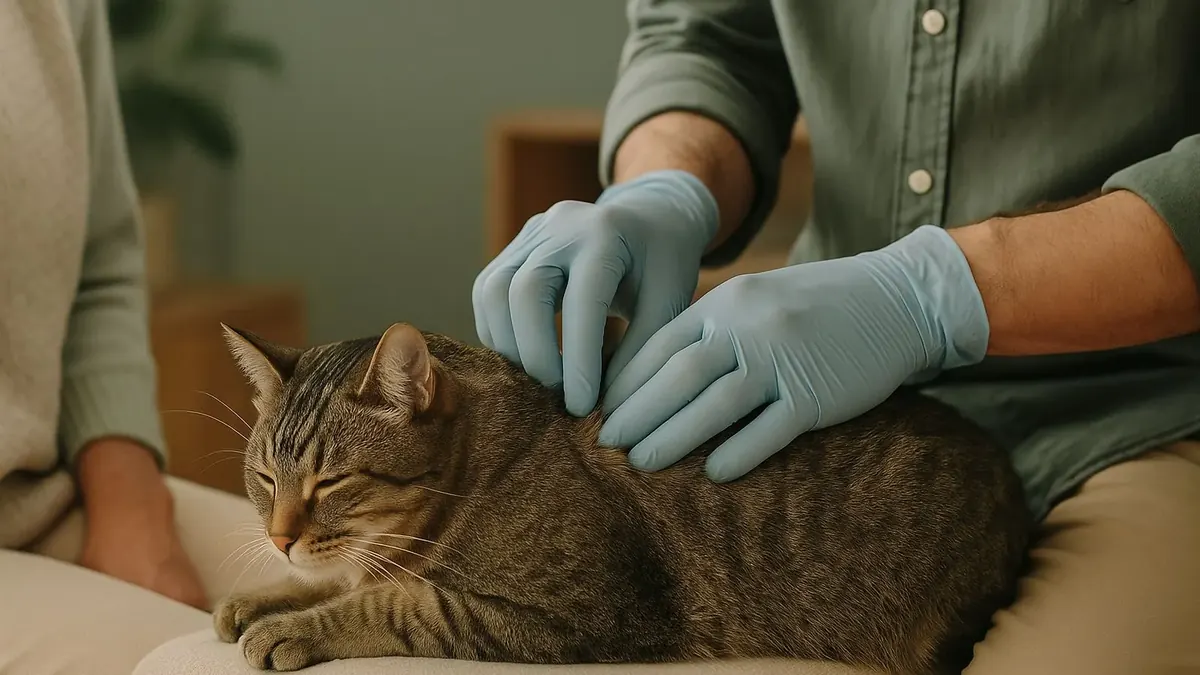
Ringworm in cats isn't a worm. It's a fungal infection of the skin and hair, which is the kind of misleading name medicine sometimes lands on and never lets go of. It's also one of the few cat skin conditions that spreads to humans, particularly children, the elderly and anyone immunocompromised. The good news: it's treatable. Below is what it looks like, how to clear it, and how to stop it touring the rest of your household.
What ringworm in cats actually is
Ringworm (dermatophytosis) is a fungal infection most commonly caused by Microsporum canis, a fungus that loves keratin, which is what your cat's skin and hair are made of. The "ring" in ringworm refers to the circular pattern lesions sometimes form on human skin. In cats, the lesions don't always look like rings. (Whoever named ringworm wasn't a cat owner.)
Ringworm is one of the most common contagious skin diseases in Australian cats, particularly in kittens, multi-cat households, shelter cats and long-haired breeds (Persians, Himalayans, Maine Coons).

How cats catch ringworm
Spores survive in the environment for months, on bedding, carpet, brushes, scratching posts, even shoes. Cats pick them up from:
- Other infected cats or dogs
- Contaminated bedding, towels, brushes or grooming tools, relevant if your grooming routine shares tools between species
- The environment (gardens, shelters, breeders, boarding catteries)
- Humans who carry spores in on shoes or clothes
- Wildlife, possums, rodents, native mammals
Some cats are asymptomatic carriers, they shed spores without showing lesions. This is part of why ringworm is so persistent in multi-cat households. The cat causing the outbreak often looks fine.
What ringworm looks like in cats
Ringworm in cats looks different to ringworm in humans. The classic round, red ring is more typical of human infection. In cats, expect:
- Patchy hair loss, circular or irregular bald spots, often starting on the face, ears, paws or tail
- Crusting and scaling, flaky, dandruff-like skin in the affected areas
- Broken hairs, hairs break off close to the skin, leaving a stubble appearance
- Mild redness, but often less obvious than with allergies or infection
- Mild itching, some cats scratch, many don't
- Generally well, most cats with ringworm don't seem unwell
Lesions are most common on the face (around eyes, ears, muzzle), front legs and paws. In long-haired cats, hair loss can be subtle until the coat parts and reveals it.
Yes, ringworm spreads to people
About half of people in close contact with an infected cat will pick up ringworm themselves. Worth knowing before you offer the kitten cuddles around.
Higher risk groups:
- Children under 12
- Elderly people
- People on chemotherapy or immunosuppressive medications
- People with eczema or other skin conditions
- Pregnant women (talk to your GP)
In humans, ringworm shows as the classic red ring on the skin, itchy, scaly, expanding outward. It's treated with topical antifungal creams from the pharmacy, plus prescription antifungals if widespread. See your GP if you suspect you've caught it.
How vets diagnose ringworm
Vets use one or more of:
- Wood's lamp, UV light that makes Microsporum canis spores fluoresce green. About half of cases show fluorescence; not seeing it doesn't rule out ringworm.
- Trichogram, plucking hairs and examining them under a microscope for spores.
- Fungal culture, the gold standard. Hair samples placed on a culture medium and observed for 1 to 3 weeks. Also used to confirm cure later.
- PCR test, newer molecular test, faster than culture, increasingly available at Australian labs.
Diagnosis matters because ringworm looks similar to flea allergy dermatitis (covered in the flea, tick and parasite treatment guide), demodex mange, bacterial skin infections and autoimmune conditions. If a dog in your household is also scratching, the itchy dog guide covers the same differentials for canine skin conditions. Treating the wrong thing wastes weeks. (And the cat is judging you the whole time.)

Treatment
Topical antifungals
Lime sulphur dips, miconazole-chlorhexidine shampoos, and topical antifungal creams (clotrimazole, miconazole) for localised lesions. Topical treatment alone is usually not enough for an established infection, used alongside oral medication.
Oral antifungals
Itraconazole is the most common oral antifungal used in Australian cats with ringworm. Effective, well tolerated, given as a capsule or compounded liquid. Treatment courses run 4 to 8 weeks, sometimes longer. Other options include terbinafine and fluconazole.
Environmental decontamination
Half the battle. Spores in the environment will reinfect a treated cat in days. Decontamination involves:
- Vacuuming daily (and discarding the vacuum bag, not emptying it)
- Washing soft furnishings and bedding in hot water with bleach where fabric allows
- Cleaning hard surfaces with diluted bleach (1 part bleach to 10 parts water) or specific antifungal disinfectants
- Confining the affected cat to one easily-cleaned area during treatment
- Disposing of porous items that can't be properly cleaned (cardboard scratchers, old toys)
How long treatment takes
Most cases clear in 4 to 8 weeks of consistent treatment. Long-haired and multi-cat households often need 2 to 4 months. Successful treatment is confirmed by negative fungal cultures, typically two negative cultures a week or two apart before considering the cat truly clear.
Don't stop treatment when lesions disappear. Spores can persist after the visible signs clear. Stopping early is the most common reason ringworm comes back.

Preventing spread in multi-cat households
If you have multiple cats and one has ringworm, treat the whole house as exposed:
- Isolate the affected cat in one easy-to-clean room
- Use disposable gloves when handling them; wash hands and arms with antifungal soap after
- Have separate bedding, food bowls and litter for each cat
- Bathe other cats with antifungal shampoo on vet advice
- Test other household cats with fungal culture, many will be carriers without symptoms
- Talk to your vet about whether prophylactic treatment of all cats is appropriate
When to see a vet
- Any new patchy hair loss, especially circular or expanding lesions
- Crusting, scaling or broken hairs on the face, ears or paws
- If anyone in your household has developed a ring-shaped rash
- Multiple cats in your household showing skin issues
- A new kitten, especially from a shelter or breeder
Treating ringworm yourself with over-the-counter products without a diagnosis can prolong the infection and make culture diagnosis harder. Get the diagnosis first. The find a vet guide can help you locate a clinic, or if symptoms are severe and worsening, see the emergency vet guide. (Most ringworm isn't an emergency. But a kitten that's also off food and lethargic is a different story.)
Ringworm is one of those conditions that looks worse than it is, treats well with patience, and rewards thorough cleaning. If you've made it to the bottom of this page, you're already taking it more seriously than half of the internet does. Note that kittens from shelter environments often arrive with a mix of infections, including cat flu alongside ringworm. If a dog in your household is also affected, the presentation and treatment are slightly different — see ringworm in dogs for the full comparison. Information here is general; ringworm diagnosis and treatment should be supervised by a registered veterinarian. If anyone in your household has skin lesions, see your GP.